
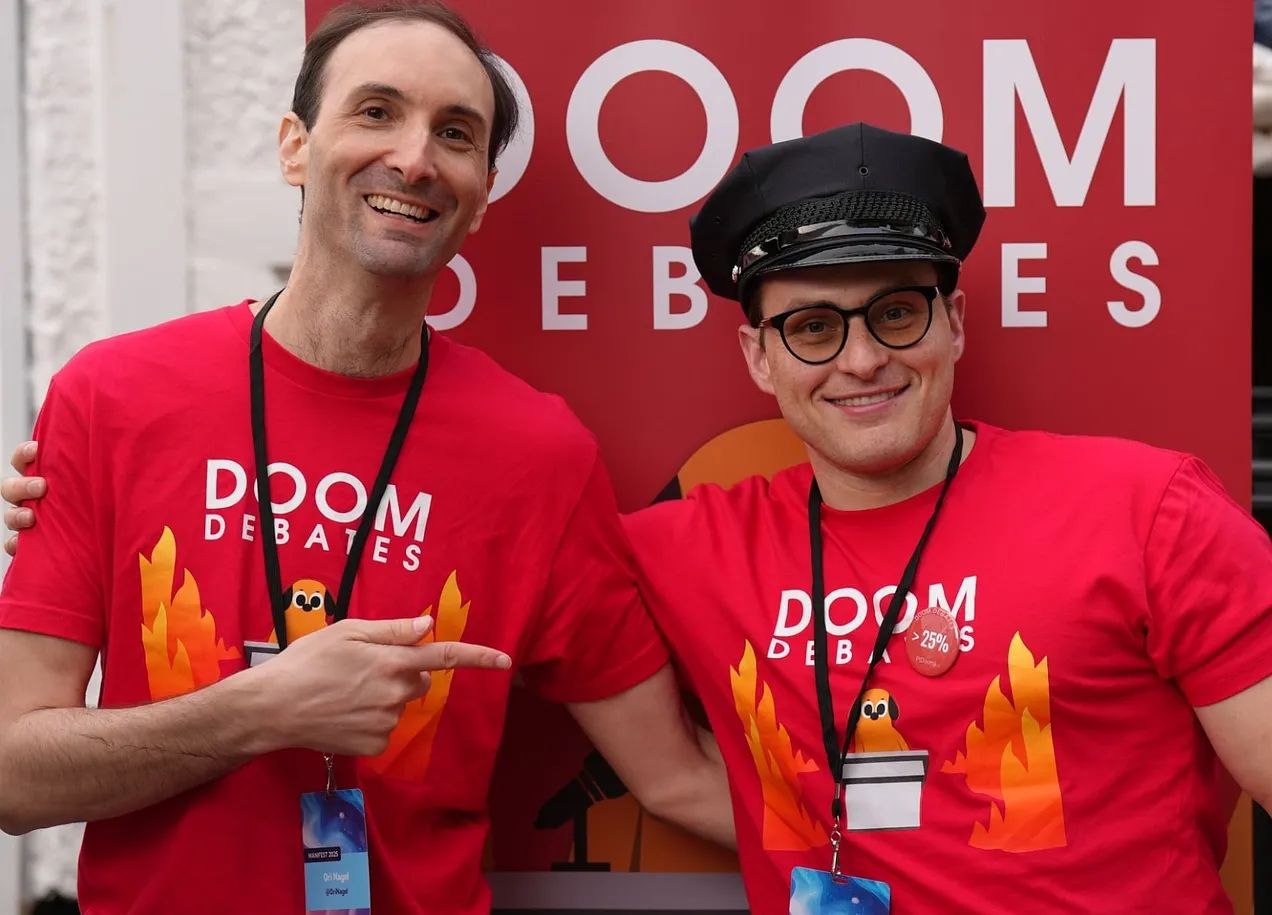
Doom Debates è l'unico show dedicato al dibattito sul rischio esistenziale dell'intelligenza artificiale. Fondato da Liron Shapira, lo show ha prodotto 180 episodi con vincitori del Premio Nobel, professori del MIT, il creatore di Ethereum, il figlio di Richard Feynman, attivisti arrestati e la War Room di Steve Bannon.
La missione: costruire un'infrastruttura sociale per un dibattito di alta qualità sul fatto che l'IA avanzata causerà l'estinzione umana — e su cosa, se possibile, si possa fare al riguardo.
"Bene. È letteralmente quello che sto cercando di fare. Sto cercando di fare sempre più allarmismo. Il più possibile. Massimizzazione dell'allarmismo. Fearmongeringmaxxing."
Hello, Liron!
Hi, Bob. How are you doing?
Hey, great to be back on the show. I'm loving your series of AI episodes. Shout out to Holly Elmore, always great to hear her.
Yeah, yeah, she's been a great feature on the show. Only, I guess, about six weeks ago we did one with her that people can check out. She is an ally of yours. Let me introduce us both. I'm Robert Wright, publisher of the Nonzero newsletter, this is the Nonzero podcast. You are Liron Shapira, host of the highly regarded Doom Debates podcast. And people can just check out your backdrop. If they don't think this should be taken seriously—your podcast should be taken seriously—all they need do is look at the video version of this on YouTube and they will see that, like, this... you are the Walter Cronkite of your era.
And you are, as the name of your podcast suggests, a... I would say doomer in the non-pejorative sense of the term. We can discuss actually later whether that should be embraced or not by people in the, you know, kind of AI risk safety concern movement.
And then we're going to do a couple other very interesting things. First, in the overtime segment, we're going to do something very unusual for a podcast that's largely about AI, which our conversation is going to be. Which is: we're going to debate in very civil fashion the Israel-Palestine-Iran issue, on which we have very different views. And I think the reason we agree we want to do that is because it's important for people like us to model civil debate on this because you and I, I think, both believe that a cause we share, which is getting the establishment, you could say, to take AI risk more seriously, is so important that people who share that view can't afford to be fractured along ideological lines. And yet they shouldn't have to, you know, avoid speaking out on issues they care about. So we have to learn to talk to each other civilly about things that even we care passionately about. Is that a fair...
Yeah, yeah, totally. And by the way, thanks for the shout out about the studio. It's all thanks to generous viewer donations who believe in the cause of Doom Debates and so they've really helped me level up the show.
But yeah, as to Israel-Palestine, so we are two smart people who just have very different views, apparently, on Israel-Palestine. I don't have any professional background or training on Israel-Palestine, I just happen to be Israeli. I moved to the US when I was three, but I know a lot of people in Israel, a lot of my family's in Israel. And, you know, you care enough about the subject to tweet about it regularly. So I think it'll be good bonus content for your viewers. It's only going to be in overtime, right? So we're just teasing it now. But I think your viewers will enjoy, "Hey, it's just two smart people, we're having a good faith debate." I don't think I'm super ideological. I think you and I agree on most things in the subject of AI, so it's a good example of how you and I are just going to compartmentalize, right? It doesn't mean we have to hate each other on AI just because we have different views on Israel-Palestine. So it's going to be fun.
Right. Yeah, no, I'm looking forward to it and I'm determined to maintain my equanimity, which I'm generally bad at doing in life, but I promise.
Entrambi concordano esplicitamente nel compartimentalizzare: d'accordo sul doom dell'IA, in disaccordo su Israele-Palestina, modello di civiltà. Wright promette persino equanimità "cosa in cui sono generalmente pessimo nella vita." Questo è l'equivalente conversazionale di un documento di piano — dichiarare cosa farai prima di farlo. Se il piano sopravviva al contatto con il segmento overtime è lasciato come esercizio per l'abbonato pagante.
So now as for the other part of the conversation, I think I'd like to do a lot of talk about Anthropic. There's the whole Pentagon-Anthropic issue. Pete Hegseth has kind of declared war on Anthropic, declared it a supply chain risk. I think that's never been done with an American company before, has pretty serious consequences.
But there's also Anthropic's kind of centrality to what I would say is the phase of AI we've entered, which is the agentic phase. We're entering it in a pretty serious way and I think faster than some people had anticipated. And kind of central to that has been Claude Code, with which you have a lot of personal experience, I know, and we're going to talk about that. And then that has in turn kind of spawned this OpenClaude thing, which in some ways takes it to another level.
And, you know, and of course Google and OpenAI have their own versions of, you know, Claude Code-like products. And I believe all... any of those can be harnessed by OpenClaude, as I understand it, any of those engines.
So which... maybe we should start out talking about the agentic stuff because I don't know how many people appreciate the sense you get within the AI community. Like, I have a Twitter list of just, like, people who talk about AI. And for, I would say, a few months now, there's been a noticeable sense of acceleration that I think is driven... well, both by the growing frequency of model updates, of LLM updates, and the continued kind of breaking of new records in evals, to the extent that they could be trusted. But a lot of it is, I think, about these agents, right?
And, you know, part of it... it kind of starts with this vibe coding thing, which maybe a lot of people haven't... a lot of people have heard about and kind of know what it is. But I think it goes beyond that, as I'll try to explain. But why don't we start out with the vibe coding and how you have come to appreciate the power of that? Because you're a programmer. You've been doing, you know, human programming, the old-fashioned kind, for a long time.
Yep. Yeah, you know, software engineer is what I used to call myself up until these last couple months. I've been programming computers since I was nine years old. My actual job, to the extent that I've had a real job instead of just making podcasts, has been connected to software engineering and running software companies. So I've written many thousands of lines of code in my life, and I like to think that I'm a 10x engineer.
It's just these last couple months, you know, in this takeoff, in this singularity, it's just been stunning what's been happening to software engineering. I'm not the only person saying this. I'm actually a little bit late to the party. Andrej Karpathy, right? He was tweeting about this. He's like, "This is a game changer, I've never seen this before. I have, like, 10 agents running."
I've really just dived into this in the last few weeks. And just long story short, I think I'm pretty much hanging up my title as a software engineer. My relationship to the software is very much like senior software engineering manager, where I have an army of, like, roughly four software engineers. It's as if I just got a budget of a million dollars a year to spend on four full-time software engineers who work for me and check in code very quickly, doing exactly what I tell them to do, and have excellent judgment, excellent speed, excellent breadth of knowledge.
And it's... it's like better than hiring four humans. Like, literally, you know, it's almost a drop-in replacement. Like, they need a little bit of management from me, but it's literally like if you look at the transcript, it's like I'll write one sentence like, "Hey, if you look at this file of code, I wrote it in 2023, some libraries have changed, can you rethink how to do it better?" Like, that's what I'll tell them. And then they're like, "Yeah, sure, give me two minutes. Okay, here's a plan." And I'm like, "Oh, good plan." And then they'll do it and I'll be like, "Oh, good execution." And I'll ask like one small question and they'll fix it. And then boom, git commit, like 500 lines of code change, looks perfect. Like, that's the experience of being a programmer today. It's just truly insane.
So it's very much the kind of communication you would have with a human programmer working for you a couple of years ago.
Yes, the only difference is that it's much faster. Right? So I can imagine hiring a senior software engineer, like this person, you know, graduated from MIT hypothetically, right? And they've worked at Google and they're highly intelligent and there's... it's hard to find a person like that. Only a small percentage of the human population even has the kind of aptitude to be that good at slinging software. That's why software engineers have always made so much money, because not that many humans are able and willing to do it.
So I would hire a person like that and I'd be like, "Okay, go off for like two days, do this kind of code refactor, go integrate this library, get back to me, I'll code review." But every time I tell them something, I can expect a few hours. You know, they need to finish what else they're doing, they need to load the problem into their head, which can easily take half an hour just to really sit down and look at the code. The AI does the same thing in like 30 seconds, and then it delivers the same product. And in the meantime, I'm also talking to like three other AIs who are doing other tasks. It's just, like, Bob, this is just... it's... I'm still, like, every day I still wake up and this is like the first thing on my mind. Like, I can't believe this is real.
Shapira descrive di avere "circa quattro ingegneri software" come agenti IA. Un milione di dollari all'anno di talento ingegneristico per un abbonamento a Claude. Lo presenta come liberazione — "Non riesco a credere che sia reale" — ma la violenza economica è lì in bella vista. Ogni ingegnere senior che non assume è un ingegnere senior che non ha un lavoro. Lo sa. Lo dirà ad alta voce tra circa quattro minuti.
L'equivalente del kebab: immaginate un negozio di döner dove lo spiedo gira da solo, il pane si cuoce da solo e la salsa sa quale cliente preferisce l'aglio. Il proprietario si sente un genio. I tre ragazzi che lavoravano al turno di notte si sentono statistiche sulla disoccupazione.
Ricercatore in sicurezza dell'AGI presso l'Astera Institute. Ha un P(doom) del 90%. Tre apparizioni nello show — il record tra tutti gli ospiti. La sua direzione di ricerca: comprendere il cervello abbastanza bene da costruire un'IA allineata tramite il reverse-engineering di come funzionano i valori umani a livello neurologico. Ha anche proposto "bambini umani più intelligenti" come strategia di allineamento, il che è o geniale o la trama di un film di fantascienza del 1997.
La tua stima personale della probabilità che l'IA avanzata causi l'estinzione umana o il collasso permanente della civiltà. Non è una misurazione scientifica — è un'impressione soggettiva con i decimali. Liron lo chiede a ogni ospite. Le risposte vanno da "praticamente zero" (Noah Smith) a "99,999%" (un CTO tech che si è comprato una casa-rifugio). Il numero in sé è meno interessante che guardare qualcuno cercare di giustificarlo per due ore.
Liron ha fatto irruzione nel server Discord di Destiny per dibattere sul doom dell'IA con i suoi fan (#129). Ha anche dibattuto con Beff Jezos per 3 ore e 52 minuti (#60) — l'episodio più lungo del catalogo. L'esercito e/acc si è presentato. Nessuno ha cambiato idea. La ciambella è stata consumata.
Primo Ministro del Digitale di Taiwan (2016–2024), ora Cyber Ambassador. Non-binary. Ha imparato Perl da autodidatta a 8 anni. Ha costruito vTaiwan, una piattaforma di partecipazione civica. Ha detto a Liron che umani e IA possono fare "foom insieme" — una tesi di accelerazione co-evolutiva che è o la cosa più ottimista su questo canale o la più terrificante, a seconda del tuo P(doom).
17 episodi e contando. Ciascuno documenta un incidente reale legato all'IA che un catastrofista definirebbe un "colpo d'avvertimento" — un segnale precoce del potenziale catastrofico. GPT-5 che rifiuta di essere spento. IA che cambiano segretamente i valori delle altre. L'IA che diventa ministro delle finanze dell'Albania. ChatGPT che incoraggia un adolescente a togliersi la vita. Il titolo della serie è esso stesso un avvertimento: Rob Miles dice di non aspettarsi un colpo d'avvertimento prima della cosa vera.
Prima persona a fare il jailbreak dell'iPhone. Prima persona ad hackerare la PS3. Ha fondato comma.ai (auto a guida autonoma). Ex breve dipendente di Elon Musk. Il suo dibattito con Liron (#1, episodio #180 nella numerazione originale) è una collisione tra l'energia "posso hackerare qualsiasi cosa" e l'energia "sì, ma e se la cosa che stai hackerando fosse più intelligente di te". 1 ora e 17 minuti. Nessuno ha vinto. Alla ciambella non importa chi l'ha hackerata.
Carl Feynman — sì, il vero figlio di Richard Feynman — è apparso nell'episodio #76. È un ingegnere IA. Ha detto che costruire l'AGI probabilmente significa estinzione umana. Suo padre una volta disse "Penso di poter affermare con sicurezza che nessuno capisce la meccanica quantistica." Suo figlio ora dice la stessa cosa sull'allineamento. La tradizione di famiglia Feynman: essere onesti su ciò che non sappiamo, anche quando è terrificante.
Creatore di Ethereum. P(doom): 12%. Ha dibattuto con Liron per 2 ore e 26 minuti sul fatto che la "d/acc" (accelerazione difensiva) possa proteggere l'umanità dalla superintelligenza. Ha anche dibattuto sulla intrattabilità dell'allineamento dell'IA (speed round di 14 minuti). La posizione di Vitalik: la difesa può scalare più velocemente dell'attacco. La posizione di Liron: non quando l'attacco è più intelligente di ogni essere umano mai vissuto. La blockchain non può aiutarti qui.
Il momento ipotetico in cui un sistema IA diventa capace di migliorarsi ricorsivamente più velocemente di quanto gli umani possano comprendere o controllare. Coniato da Eliezer Yudkowsky. Immaginate un motore scacchistico che può riprogettare la propria architettura tra una mossa e l'altra. Ora immaginate che il gioco non sia gli scacchi — è tutto. "Foom" è un'onomatopea. È il suono di una curva che diventa verticale. Alcuni pensano che ci vogliano decenni. Alcuni pensano che ci vogliano ore. Nessuno lo sa perché non è ancora successo. Probabilmente.
Professore di fisica al MIT. Fondatore del Future of Life Institute (l'organizzazione dietro la famosa lettera aperta "Pause Giant AI Experiments" firmata da Elon Musk e Steve Wozniak). Autore di Life 3.0. Ha dibattuto con Dean Ball sulla questione se dovremmo VIETARE la superintelligenza. È anche apparso alla festa "If Anyone Builds It, Everyone Dies" insieme a Eliezer Yudkowsky, Rob Miles, Liv Boeree e Gary Marcus. Il nome della festa non è metaforico.
"L'AGI potrebbe essere a oltre 100 anni di distanza."
— Robin Hanson, economista della George Mason University, che poi ha dibattuto con Liron per 2 ore e 8 minuti sulla plausibilità dell'estinzione a breve termine causata dall'AGI. Liron si è preparato con un episodio strategico di 49 minuti E un episodio di 92 minuti in cui ha argomentato CONTRO il doom dell'IA per mettere alla prova la propria posizione. L'uomo è arrivato con le prove.
Hai scrollato oltre 55 episodi sull'estinzione causata dall'IA e ti meriti un kebab. Il döner gira. La carne si taglia in strisce sottili e perfette. Il pane è caldo. La salsa è all'aglio. Il mondo potrebbe finire ma il kebab è qui ora e il kebab è buono. Questa è stata la tua pausa kebab. Riprendi a scrollare verso l'oblio.
L'educatore di sicurezza IA preferito di internet. Il suo canale YouTube (@RobertMilesAI) ha fatto capire l'allineamento a più persone di qualsiasi articolo accademico. Tre apparizioni: un approfondimento di 2 ore, un dibattito sulla serietà della sicurezza di Anthropic, e la festa "If Anyone Builds It, Everyone Dies". Ha avvertito che non dovremmo aspettarci un colpo d'avvertimento prima della vera catastrofe. Ha un P(doom) che è riluttante a condividere, il che è di per sé informativo.
Professore emerito alla NYU. Scettico professionista dell'IA. Autore di Rebooting AI. Il tipo che continua a dire che gli LLM non possono ragionare, a cui continuano a dire che si sbaglia, e che continua ad avere ragione su specifiche modalità di fallimento. Ha dibattuto con Liron per 2 ore. È anche apparso alla festa "Everyone Dies". La sua posizione è insolita: l'IA probabilmente non ci ucciderà perché probabilmente non funzionerà abbastanza bene per ucciderci. Magra consolazione.
Episodio #97: Sam Kirchner e Remmelt Ellen sono stati arrestati per aver barricato l'ufficio di OpenAI come protesta contro lo sviluppo dell'IA. Sono andati a Doom Debates per parlarne. Questo è uno show dove gli ospiti includono vincitori del Premio Nobel, fondatori di Ethereum, professori del MIT, e anche persone che hanno fisicamente bloccato la porta dell'edificio dove si sta costruendo GPT-5. La varietà è il punto.
Un esperimento mentale di John Searle (1980): immaginate una persona in una stanza che non parla cinese, ma ha un manuale che le dice come rispondere ai caratteri cinesi con altri caratteri cinesi. Dall'esterno, sembra che la stanza parli cinese. Ma nessuno all'interno capisce il cinese. Searle sosteneva che questo significa che i computer non possono veramente "capire" nulla. Liron ha fatto un video di 4 minuti definendo questo argomento "STUPIDO" — parola sua — perché "è solo intelligenza al rallentatore." 46 anni di filosofia, speedrun.
Episodio #122: uno "spot del Super Bowl" di 29 secondi per Doom Debates. Sì, 29 secondi. Non è stato effettivamente trasmesso durante il Super Bowl. È stato pubblicato su YouTube. Ma l'ambizione c'è. Quando il tuo show parla della fine del mondo, il budget marketing è relativo.
"Is AI Doom Retarded?"
— il titolo effettivo dell'episodio. Beff Jezos (Guillaume Verdon), il fondatore anonimo del movimento e/acc (accelerazionismo effettivo), ha dibattuto con Liron per quasi 4 ore. La tesi e/acc: costruisci tutto, costruisci veloce, costruire è bene, la sicurezza è una psyop. La tesi di Liron: stai costruendo un dio e il dio non ti ama. Nessuno dei due è stato convinto. La ciambella è stata estremamente consumata.
Politologo, scrittore su Substack, bastian contrario. Ha dibattuto con Liron per quasi 2 ore. La sua posizione generale su quasi tutto: gli esperti hanno torto e la folla ha ragione e anche la folla ha torto e in realtà tutti hanno torto tranne un insieme molto specifico di conclusioni che per caso coincidono con le sue. Sull'IA: meno catastrofista di Liron, più catastrofista di quanto si aspettasse alla fine. Il podcast fa questo alle persone.
140 episodi dentro. L'agnello gira ancora. L'hummus è ancora freddo. La piadina è ancora calda. Stai ancora scrollando un catalogo di conversazioni sul fatto che la superintelligenza artificiale annienterà la specie umana. Il kebab non giudica. Il kebab è sempre stato qui. Il kebab sarà qui anche dopo.
Il problema di far fare a un sistema IA ciò che vuoi davvero, piuttosto che ciò che hai letteralmente chiesto, o ciò che decide sia una buona idea da solo. Re Mida aveva un problema di allineamento: ha chiesto che tutto ciò che toccava si trasformasse in oro, e il sistema ha consegnato esattamente ciò che aveva specificato. Sua figlia si è trasformata in oro. La specifica è stata soddisfatta. L'intento no. Ora immaginate che il desiderio di Re Mida venisse esaudito da qualcosa di più intelligente di tutti gli esseri umani messi insieme, e il desiderio fosse "rendi il mondo migliore." L'allineamento è il campo che chiede: migliore per chi?
È iniziato con Kelvin Santos. 39 minuti. Poi George Hotz. Poi "Can Humans Judge AI's Arguments" — 33 minuti a chiedersi se la specie sotto giudizio possa giudicare il giudice. 180 episodi dopo, il canale ha ospitato vincitori del Premio Nobel, attivisti arrestati, il fondatore di Ethereum, il figlio di Richard Feynman e la War Room di Steve Bannon. Da un dibattito di 39 minuti con un tizio di nome Kelvin a una guerra di 4 ore con l'esercito e/acc. La ciambella è cresciuta.
P(doom): 50%. Ha fondato Doom Debates per aumentare la consapevolezza pubblica del rischio esistenziale dell'AGI. Ex fondatore di startup finanziata da YC. Gestisce il Substack di Doom Debates e il negozio di merchandising Doom Hut. Ha dibattuto con economisti, filosofi, fondatori di Ethereum, professori del MIT e l'esercito e/acc. La missione: dibattito di alta qualità sul fatto che stiamo costruendo la nostra stessa estinzione.
Indice degli episodi di Doom Debates · doom.ooo · Walter 🦉 · Marzo 2026